 MasterPIZZA
In short. For 4 pizzas of 250 g at 70 % hydration: on Thursday night the biga (174 g of flour, 78 g of water, 1.74 g of fresh yeast), on Friday morning the poolish (116 g of flour, 116 g of water, 0.22 g of fresh yeast). On Friday evening you bring them together with 289 g of flour, 211 g of water and 16.2 g of salt, and carry on with the fridge until Saturday evening.
Hands-on time: 5 minutes for the biga, 5 for the poolish, 20 for the dough. Difficulty: medium. If this is your first time with a preferment, start with the biga guide.
Two different characters
Biga and poolish are both preferments: a piece of dough made ahead, with part of the flour, part of the water and a little yeast. But they have little in common.
Biga is dry: only 45 % water compared to its flour. When you make it, it doesn't even become a dough, it stays a bowl of lumps. It ferments slowly, for 16-24 hours somewhere cool, and develops intense, slightly tangy aromas. To the final dough it gives strength and flavour.
Poolish is the opposite: as much water as flour. What you get is a smooth batter, almost a cream, that fills with bubbles in a few hours. With all that water the enzymes work fast and the gluten relaxes. To the final dough it gives extensibility and lightness: it stretches easily and the crust opens up.
So which is better, poolish or biga? Using them together means you don't have to choose: the flavour and structure of the biga, the softness of the poolish. The hard part is not the handling, which is very simple, but the maths and the timing. Let's take them one at a time.
How to split the flour
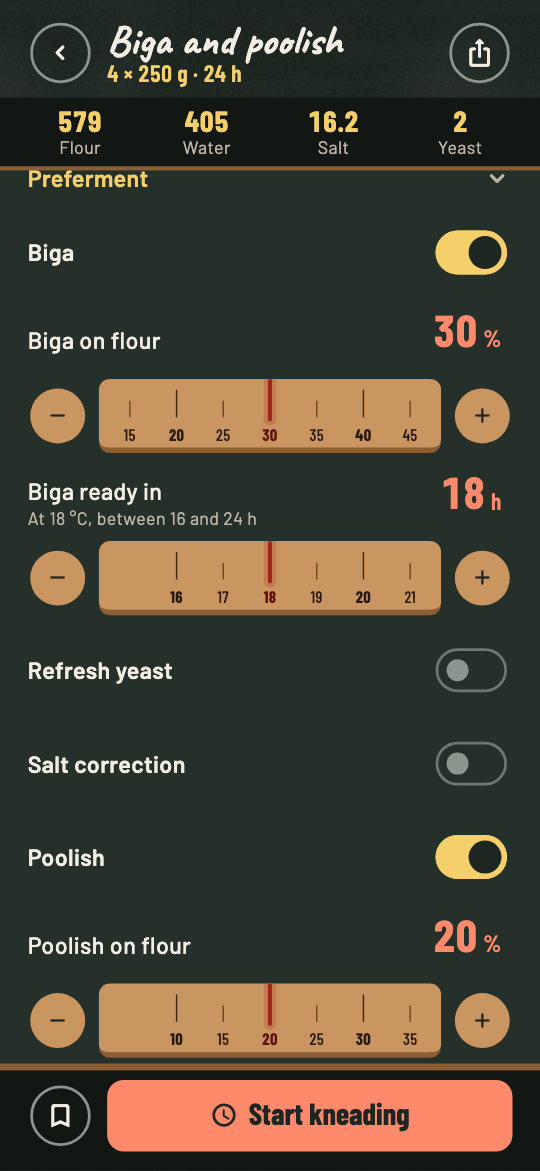
We are making 4 pizzas of 250 g at 70 % hydration: 579 g of flour in all. We put 30 % in the biga and 20 % in the poolish, the right proportion to start with. The remaining flour goes into the final dough.
With the water you need to be a little more careful. The biga uses little, the poolish a lot, and what is left for the final dough is the difference. With these proportions, biga and poolish take half the flour and almost half the water: that leaves 211 g to finish the dough, which is enough to work it calmly.
That is why you can't overdo the poolish. Every gram of flour you put in it brings a gram of water along; with a low hydration and lots of poolish, the water runs out before the flour does and the final dough becomes impossible to bring together. The rule is simple: together, biga and poolish must not exceed the dough's flour, and their water has to fit inside the dough's water.
The timing: both ready at 7:40 pm
Now the timing. We want pizza on Saturday at 8 pm, with the final dough on Friday evening at 7:40 pm and a night in the fridge. Biga and poolish must both be ready at that time, but they ferment differently: the biga wants about 18 hours, the poolish 12.
Counting backwards, the poolish has to be made on Friday morning at 7:40 am, before you leave the house. The biga, with 18 hours, would have to be made at 1:40 am: nobody wants to do that. So you make it on Thursday at 11:30 pm, before bed, and let it ferment about 20 hours, still within the right window.
Step 1: the biga, Thursday night
Dissolve 1.74 g of fresh yeast (or about 0.7 g of instant dry yeast) in 78 g of cool water, add 174 g of strong flour and mix by hand for two or three minutes, just until the water has disappeared. You are left with walnut-sized lumps, dry and loose: that is right, don't knead it. Cover the bowl, leaving a small gap, and put it in the coolest spot in the house, around 18 °C (64 °F).
Step 2: the poolish, Friday morning
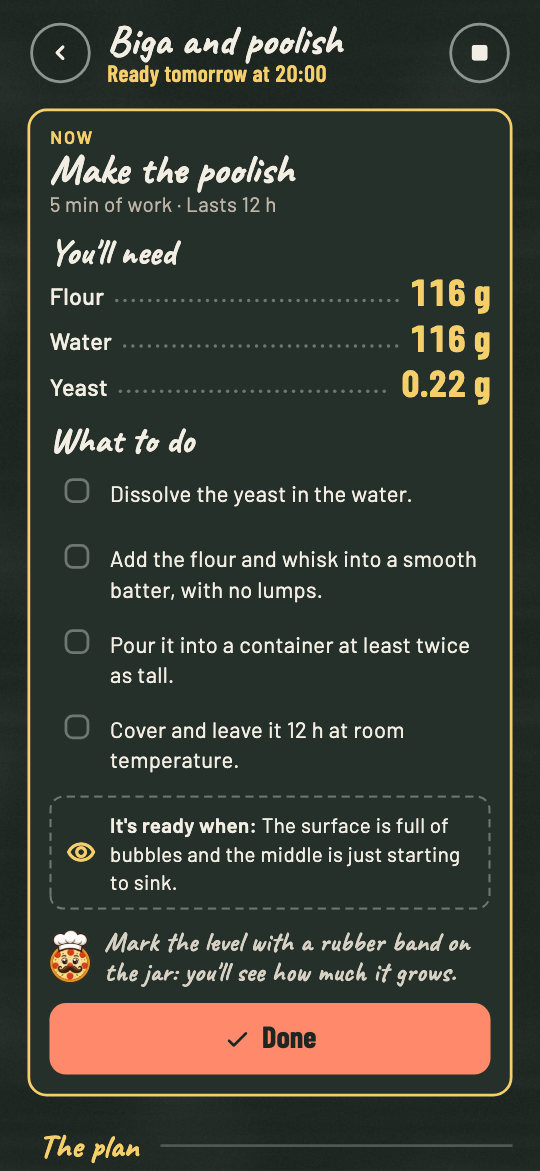
The next morning, before your coffee, it is the poolish's turn. Weighing 0.22 g of yeast is impossible with a kitchen scale: dissolve 1 g of fresh yeast in 10 g of water and take a little over 2 g of it (with instant yeast it is less than a tenth of a gram, so the water trick is the only way). Put it in a tall container with the rest of the 116 g of water, add 116 g of flour and whisk until you have a smooth batter, with no lumps.
Use a tall, clear container, because the poolish will grow a lot. A trick: put a rubber band around the jar at the level of the poolish. This evening you will see at a glance how much it has risen. Cover it and leave it at room temperature.
How to tell when they are ready
In the evening, before mixing, check them both. The biga is ready when it has puffed up, the lumps have merged, and it has an intense smell of bread and yoghurt, slightly winey. Breaking a lump open, you see lots of small bubbles inside.
The poolish is ready when it has at least doubled, the surface is covered in bubbles and the middle is just starting to sink. If it collapsed a while ago, it has gone a little too far: use it straight away, without waiting.
Step 3: mix the dough, Friday evening
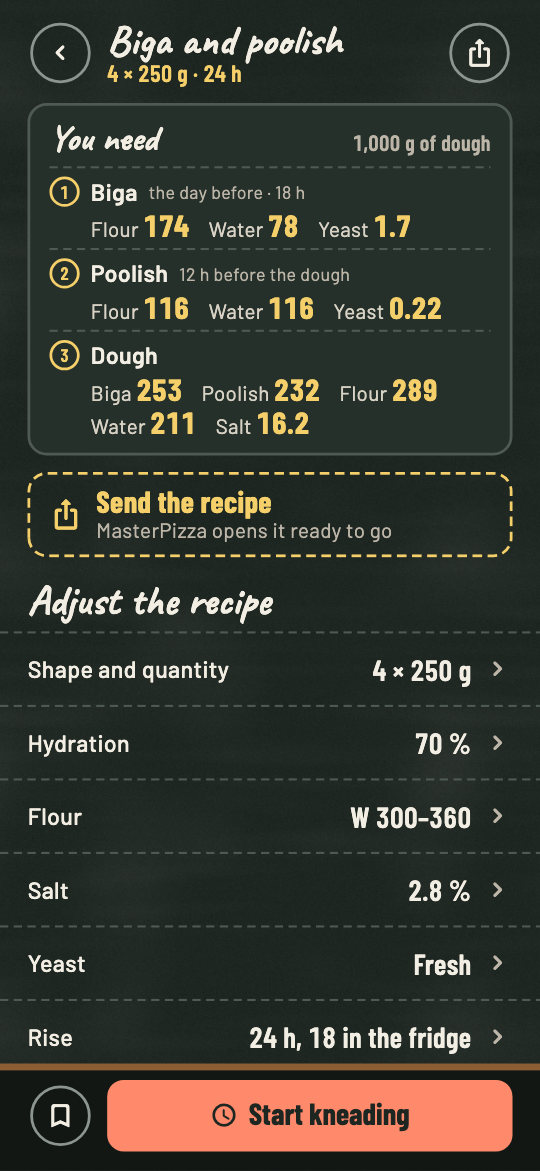
Now they come together. Break the biga into pieces in the big bowl and pour half of the dough's 211 g of water over it. Squeeze and stir with your hands until the biga dissolves into a thick cream. Then pour in the poolish, all of it, and stir again: the two blend quickly.
Add the 289 g of flour and knead until you can't see any more lumps of biga. Then the salt, 16.2 g, with a splash of water, and finally the remaining water, a little at a time. No extra yeast needed: there is already enough in the biga and the poolish.
You will feel the difference from a normal dough straight away: it is soft but strong, it stretches without tearing. That is exactly the effect of the two preferments together.
Step 4: from here on, as usual
From here the dough carries on like a normal 24-hour cold fermented dough. Two hours' rest, covered, with three sets of folds in the first hour, then into the fridge at 10 pm. On Saturday at 4 pm you take it out, shape the balls and let them rise for four hours. At 7:15 pm you turn on the oven, at 8 pm you eat. All the details are in the guide to cold fermentation in the fridge.
Other proportions
Once you are comfortable, you can play with the proportions. More biga means more flavour and more strength; more poolish more extensibility, but also less water left for the final dough. Here is the same dough with different proportions:
| Biga + poolish | Biga | Poolish | + Flour | + Water |
|---|---|---|---|---|
| 20 + 20 % | 116 g + 52 g water | 116 g + 116 g water | 347 g | 237 g |
| 30 + 20 % | 174 g + 78 g water | 116 g + 116 g water | 289 g | 211 g |
| 40 + 20 % | 231 g + 104 g water | 116 g + 116 g water | 231 g | 185 g |
| 30 + 30 % | 174 g + 78 g water | 174 g + 174 g water | 231 g | 153 g |
If it is your first time, stick to 20 + 20 or 30 + 20: the final dough still has enough flour and water to work it without rushing.
If something goes wrong
The final dough is too stiff. Too little water was left after the biga and the poolish. Next time reduce the poolish or raise the hydration.
The final dough is slack and falls apart. The flour was too weak for all those hours of fermentation. Use a strong flour (a high-protein bread flour or a 00 for long fermentation), at least for the biga.
The biga is lagging behind. It was too cold: below 16 °C (61 °F) it slows down a lot. Give it an hour or two somewhere warmer.
The poolish has collapsed. It was too warm, or there were too many hours. In summer shorten it, or put it in the fridge for the last few hours.
With MasterPIZZA
In the recipe you open Preferment and switch on both the biga and the poolish, each with its own percentage and hours. The app immediately splits flour and water into the three stages and checks the limits for you: if you ask for more poolish than your water allows, the ruler stops by itself.
When you tap Start kneading and choose when you want to eat, the kneading guide works out the times for both, moves the biga out of the night and alerts you when it is time to make each one.
Questions
Can you use biga and poolish together?
Yes: they are two different preferments that ferment side by side and come together in the final dough. The biga (dry) brings strength and aroma, the poolish (wet) makes the dough more extensible.
How much biga and how much poolish should I use?
A good start is 30 % of the flour in the biga and 20 % in the poolish. Together they must not exceed 100 % of the flour, and their water has to fit within the dough's total water.
When do you make biga and poolish?
Each on its own schedule, so both are ready for the dough: biga ferments about 18 hours at 18 °C (64 °F), poolish 12 hours at room temperature. Usually the biga is made the night before and the poolish in the morning.
Poolish vs biga: what is the difference?
Biga has little water (about 45 % of its flour) and ferments slowly: it brings aroma and strength. Poolish has as much water as flour (100 % hydration), ferments faster and makes the dough soft and extensible.
Do I need more yeast in the final dough?
Usually not: the biga and the poolish bring the yeast. If the dough has to rise quickly or the kitchen is cold, you can add a pinch of extra yeast.

Let MasterPIZZA do the maths
Pick your dough balls, hours and temperature: the app gives you the amounts to the gram and guides you step by step, with alerts. Free for Android.
Get it on Google Play ↗