 MasterPIZZA
In short. For 4 pizzas of 250 g: 579 g of flour, 405 g of water, 16.2 g of salt and 0.45 g of instant dry yeast (1.0 g if fresh). You mix on Friday evening, let it rest 2 hours, put it in the fridge for 18 hours, shape the balls on Saturday afternoon and bake 4 hours later.
Hands-on time: half an hour in the evening, a quarter of an hour the next day. Difficulty: easy, and it is the simplest way to make a really good pizza.
Why the fridge
Think of the fridge as a way to slow down time, but only for part of the dough.
At 4 °C (39 °F) yeast almost falls asleep: it produces very little gas and the dough barely grows. But the flour doesn't. The enzymes it contains keep working even in the cold, and for hours they break starches down into sugars and proteins into smaller pieces.
You can taste the result in three ways. The pizza is more flavourful, because those sugars and aromas weren't there before. It is easier to digest, because part of the work your stomach would do has already been done by the dough. And the crust browns better in the oven, golden and fragrant, precisely thanks to those freed-up sugars.
Then there is an advantage that counts as much as flavour: with the fridge, you decide the timing. You mix when you have half an hour free, in the evening after dinner, and the next day you don't have to plan your day around the pizza.
The plan: Saturday pizza night
Let's make a 24-hour dough, 18 hours of it in the fridge, the classic. You want pizza on Saturday at 8 pm. You start on Friday evening, at about 7:40 pm, and on Saturday you only work from 4 pm onwards.
The ingredients for 4 pizzas of 250 g, at 70 % hydration:
- 579 g of flour: a medium-strength pizza flour (W 260-300, around 12 % protein; a 00 pizza flour or a bread flour) is perfect for 24 hours.
- 405 g of water: at room temperature in spring and autumn, cool in summer, lukewarm (about 25 °C / 77 °F) in winter.
- 16.2 g of salt.
- 0.45 g of instant dry yeast, or 1.02 g of fresh yeast.
Step 1: mix and bulk rise, Friday evening
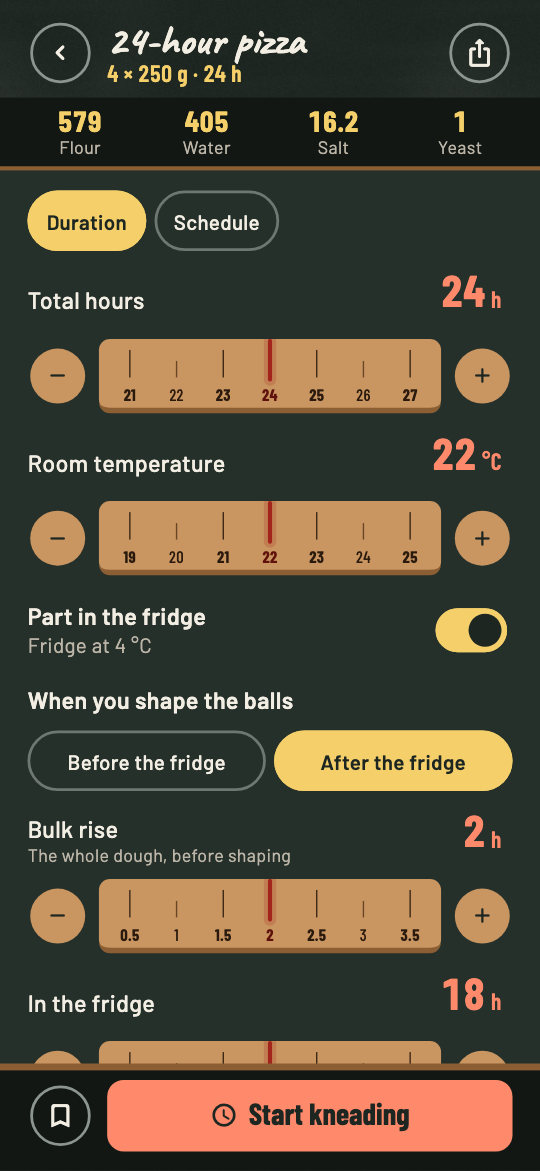
Dissolve the yeast in almost all the water, add the flour and mix until there is no dry flour left. Then the salt, with a splash of water, and the last of the water a little at a time. Knead until the dough is smooth and elastic: about ten minutes by hand.
Now something important that many people skip: don't put the dough straight into the fridge. Cover the bowl and leave it 2 hours at room temperature. This first rise is called the bulk rise (or bulk fermentation), and it gets the yeast going before the cold. A dough that goes into the fridge as soon as it is mixed stays asleep, barely grows and is dense the next day.
With 70 % water the dough is soft: in the first hour do three sets of folds, one every 20 minutes. With a wet hand pull one edge up and fold it over the top, turning the bowl. It takes thirty seconds and gives the dough the strength to get through the night.
Step 2: into the fridge
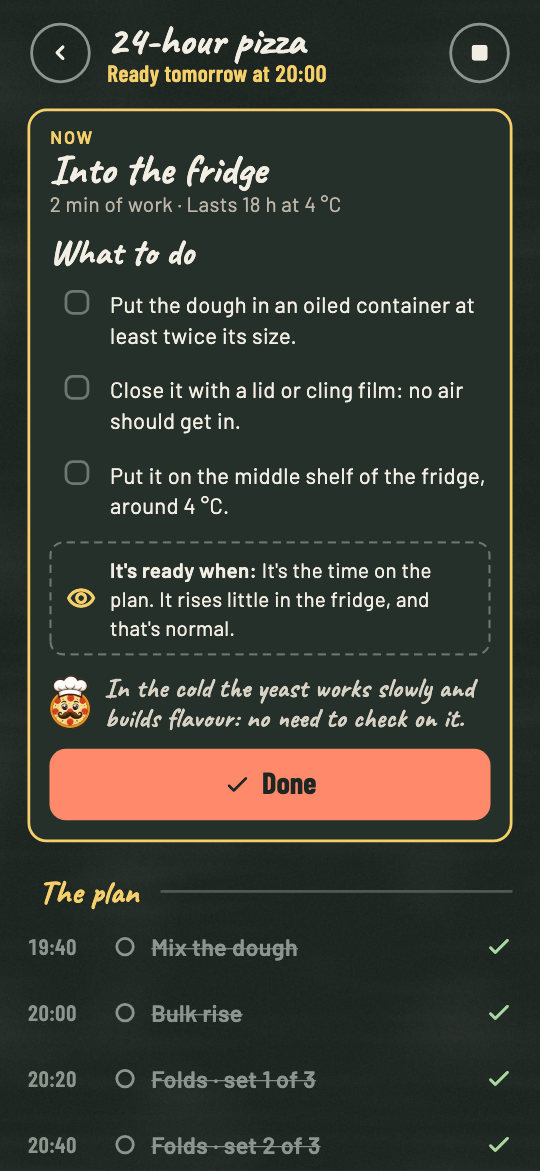
At about 10 pm put the dough in a lightly oiled container, big enough to hold twice its volume, and close it well with a lid or cling film. If it stays open, the surface dries out and forms a skin.
Put it on the middle shelf of the fridge, away from the door: that is where the temperature stays most stable. And then forget about it until the next day.
One thing that worries people the first time: the next morning, if you open the fridge for a peek, the dough will look almost the same as the night before. That is normal. In the cold the yeast works very slowly, and the best is yet to come.
Step 3: dough balls and final rise, Saturday afternoon
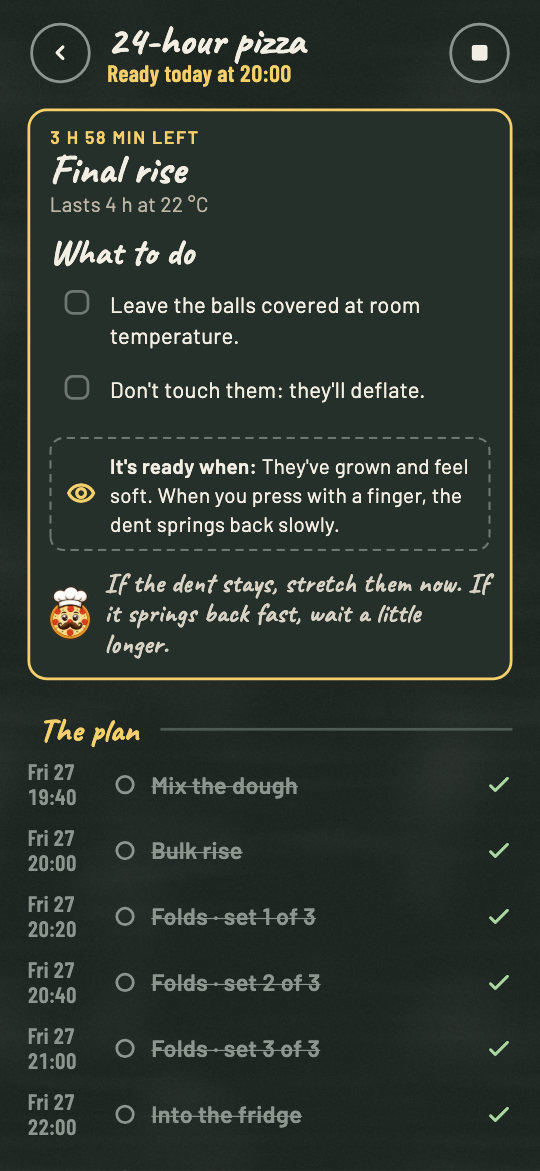
At 4 pm, four hours before baking, take the dough out. Tip it onto the worktop and divide it straight away into 4 pieces of 250 g, while it is still cold: cold dough is firmer and easier to work.
To shape a dough ball, fold the edges of the piece towards the centre, turn it seam side down and roll it on the worktop between your cupped hands, pulling the surface tight. You want a smooth, taut little ball. Put them in a container or on a floured tray, well spaced, and cover them.
Now the dough balls come back to room temperature, the yeast wakes up and starts working for real. This second rise is called the final rise, or proof. In four hours the balls grow by about half again, soften and spread out a little.
How to tell when they are ready
Gently press a dough ball with your finger. If the dent springs back slowly and leaves a small dimple, it is ready. If it bounces back instantly, wait another half hour. If it leaves a hole that never fills, it has gone too far: stretch it and bake it straight away.
Smell it too: it should smell of bread and yeast, slightly tangy. A strong smell of alcohol means the dough has over-proofed.
Step 4: the oven
At 7:15 pm turn the oven on as high as it goes, with the pizza stone, steel or tray inside: it has to heat through properly, not just the air. At 8 pm stretch the first dough ball, top it and bake. Cold fermented pizza, with all that maturing, browns quickly: keep an eye on it.
Dough balls before or after the fridge?
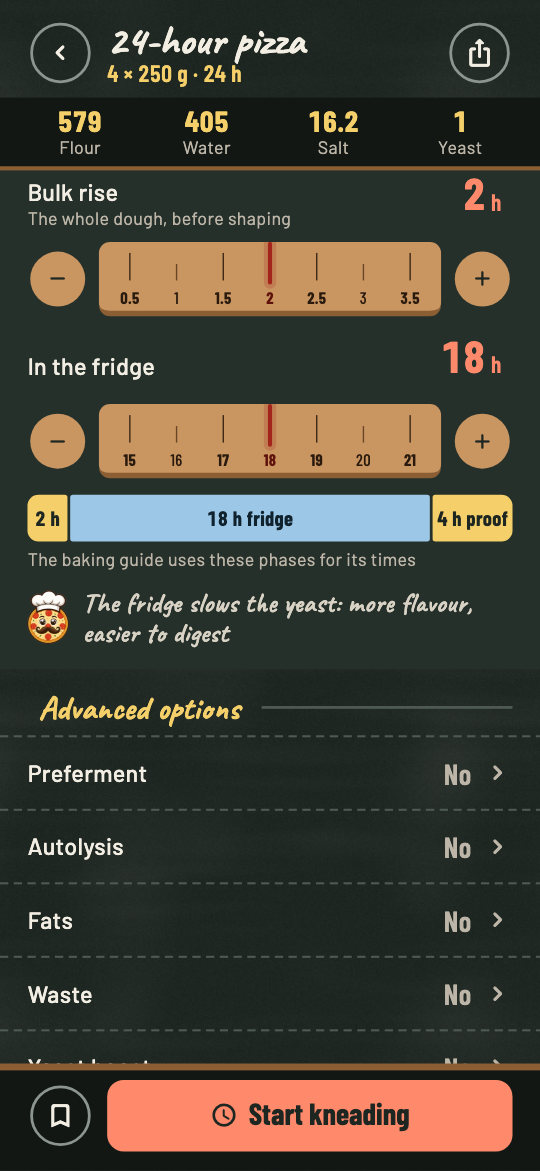
In our tutorial we put the whole dough in the fridge and shaped the balls afterwards. It is the most practical choice if your fridge is small: a single bowl takes up little room, and cold dough divides easily.
The alternative is to shape the dough balls before the fridge, right after the bulk rise. The next day you take them out and they are already set for the final rise, without even dirtying the worktop. It is the best choice for long cold ferments, because the balls mature in their final shape and stay more even. You do need a big container, though, because they spread as they grow.
Here is the same schedule with the dough balls shaped before the fridge:
| Day | Time | Step | Wait |
|---|---|---|---|
| Friday | 19:40 | Mix the dough | |
| Friday | 20:00 | Bulk rise | 2 h |
| Friday | 20:20 | Folds | 3 sets, every 20 min |
| Friday | 22:00 | Shape the balls | |
| Friday | 22:00 | Into the fridge | 18 h |
| Saturday | 16:00 | Final rise | 4 h |
| Saturday | 19:15 | Turn on the oven | 45 min |
| Saturday | 20:00 | Stretch and bake |
48 and 72 hours
Once your 24-hour pizza turns out well, the temptation to go longer comes on its own. With a 48 or 72-hour cold ferment the flavour gets deeper and the pizza even lighter. The method is the same: only the hours in the fridge and the yeast change.
What surprises people is how little the amount changes. Going from 24 to 48 hours, the instant yeast drops from 0.45 g to 0.33 g, and at 72 hours it is still 0.25 g. The reason is that in the fridge yeast barely works: what counts is mostly the time outside, which always stays at 6 hours.
| In total | In the fridge | Out | Instant dry yeast | Fresh yeast |
|---|---|---|---|---|
| 24 h | 18 h | 2 + 4 h | 0.45 g | 1.02 g |
| 48 h | 42 h | 2 + 4 h | 0.33 g | 0.74 g |
| 72 h | 66 h | 2 + 4 h | 0.25 g | 0.58 g |
More hours call for a stronger flour: for 48-72 hours choose a W of 300-350, which in practice means a 00 flour sold for long fermentation or a high-protein bread flour (13 % or more), or blend some into your usual flour. Beyond three days the dough starts to weaken and turn too sour: better to stop there.
Summer and winter
The 6 hours outside the fridge weigh far more than the 18 inside, so the temperature of your kitchen changes the amount a lot. In a cool house in winter, at 18 °C (64 °F), you need 0.74 g of instant yeast; in summer, at 26 °C (79 °F), 0.30 g is enough.
| Kitchen | Instant dry yeast | Fresh yeast | |
|---|---|---|---|
| 18 °C | Winter, cool house (64 °F) | 0.74 g | 1.69 g |
| 22 °C | Spring and autumn (72 °F) | 0.45 g | 1.02 g |
| 26 °C | Summer (79 °F) | 0.30 g | 0.67 g |
In summer use water from the fridge to mix, so the dough doesn't start off warm. In winter, if the kitchen is really cold, give the final rise an extra hour.
More or fewer pizzas
| Dough balls of 250 g | Flour | Water | Salt | Instant dry yeast | Fresh yeast |
|---|---|---|---|---|---|
| 2 | 289 g | 203 g | 8.1 g | 0.22 g | 0.49 g |
| 4 | 579 g | 405 g | 16.2 g | 0.45 g | 1.02 g |
| 6 | 868 g | 608 g | 24.3 g | 0.70 g | 1.59 g |
| 8 | 1,157 g | 810 g | 32.4 g | 0.97 g | 2.20 g |
With amounts under a gram it pays to dissolve 1 g of yeast in 10 g of water and weigh the water: for 0.45 g of instant yeast you use about 4.5 g of it.
If something goes wrong
The dough balls spread out like pancakes. Too much water for the flour you used, or the rise went on too long. Try a stronger flour or lower the hydration a little.
The surface dried out. The container wasn't closed properly. A film of oil on the dough helps.
The dough tears when you stretch it. It is still cold or under-proofed: leave it out for another hour.
It tastes too sour or of alcohol. Too much yeast, or too many hours out of the fridge. Cut the amount or shorten the bulk rise.
With MasterPIZZA
In the app you switch on Part in the fridge, choose the total hours and how many of them go in the fridge, and whether to shape the balls before or after. MasterPIZZA recalculates the yeast for the temperature of your kitchen and the hours you chose.
Then the kneading guide takes you from start to finish: it alerts you for the folds, when to put the dough in the fridge, when to take it out and when to turn on the oven, even when the app is closed. To plan your days, read the guide to the pizza dough schedule.
Questions
How much yeast for a 24-hour cold fermented pizza dough?
For 4 dough balls of 250 g (579 g of flour), about 0.45 g of instant dry yeast or 1.0 g of fresh yeast, with 18 hours in the fridge and 6 out.
How much yeast for a 48-hour cold ferment?
For 4 dough balls of 250 g, about 0.33 g of instant dry yeast or 0.74 g of fresh, with 42 hours in the fridge, 2 hours of bulk rise and 4 of final rise.
How long before baking should I take the dough out of the fridge?
Usually 3-4 hours before baking, covered, at room temperature. In summer less may do, in winter you may need more: it has to become soft and puffy again before you stretch it.
Should I shape the dough balls before or after the fridge?
Shaped before the fridge, the balls are ready to stretch when you take them out: handy for long cold ferments. Shaped after, the dough takes less room in the fridge, but you have to shape the balls a few hours before baking.
Can pizza dough stay in the fridge for 72 hours?
Yes, with little yeast and a strong flour (W 300 or more, a high-protein bread flour or 00 for long fermentation). Beyond three days the dough tends to weaken and turn too sour.
My dough hasn't risen in the fridge: is that normal?
Yes: at 4 °C (39 °F) yeast works very little, and the dough barely grows in the fridge. Most of the rising happens in the hours outside, before and after the fridge.

Let MasterPIZZA do the maths
Pick your dough balls, hours and temperature: the app gives you the amounts to the gram and guides you step by step, with alerts. Free for Android.
Get it on Google Play ↗