 MasterPIZZA
In short. For a 30×40 cm (12×16 in) pan at normal thickness: 600 g of dough, that is 337 g of flour, 253 g of water, 9.4 g of salt and 0.59 g of fresh yeast (about 0.25 g of instant dry). You mix it in the evening, do three sets of folds, put it in the fridge for 18 hours, and the next day spread it in the pan 4 hours before baking.
Hands-on time: 20 minutes in the evening, 10 the next day. Difficulty: easy, easier than a round pizza: no stretching skills needed.
Where the magic number comes from
Anyone making pan pizza for the first time asks the same question: how much dough goes in?
The answer depends on two things: how big the pan is and how tall you want the pizza. For a pizza of normal thickness, soft inside and crisp underneath, you use about half a gram of dough for every square centimetre of pan.
A 30×40 cm pan has 30 × 40 = 1,200 cm². Multiplied by half a gram, that makes 600 g. That is the whole secret.
The same rule works for any pan you have at home, as long as you measure it in centimetres (an inch is 2.54 cm). The classic American 9×13-inch pan is about 23 × 33 cm, so 759 cm²: about 380 g of dough. A 10×14-inch Detroit-style pan is about 25 × 35 cm: around 438 g. A US half sheet pan (13×18 in, about 33 × 46 cm) has 1,518 cm²: roughly 760 g. For a round pan you work out the area from the radius: a 30 cm (12 in) pan has a radius of 15, and 15 × 15 × 3.14 makes 707 cm², so about 350 g.
If you want it lower and crunchier, go down to 0.375 g per cm² (450 g for the 30×40). If you want it tall like a focaccia, or like a thick Sicilian or Detroit-style pizza, go up to 0.75 (900 g). The amounts for every thickness are further down.
What you need
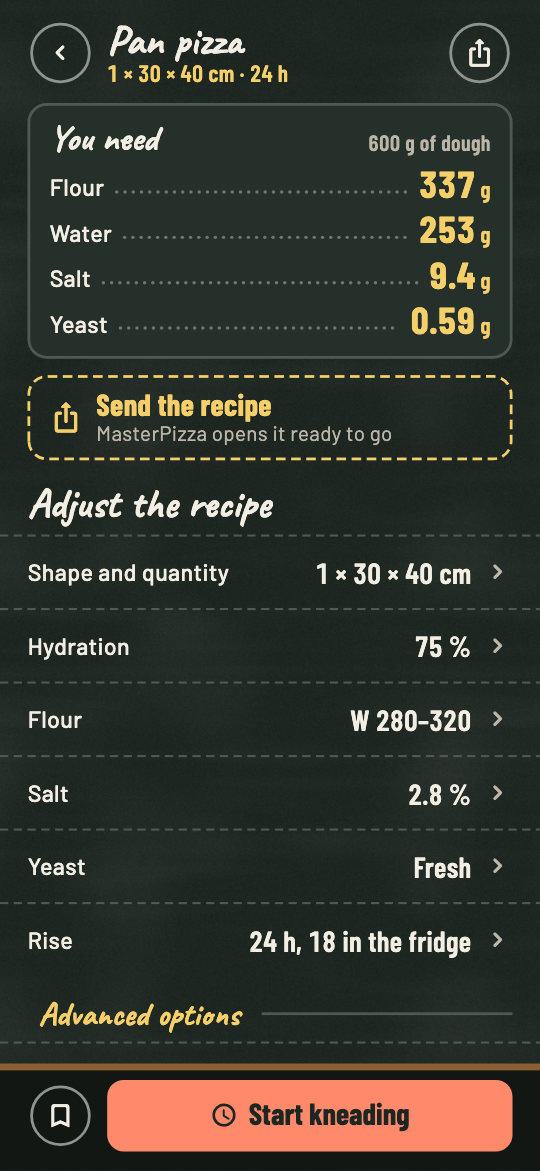
We are making a 30×40 pan at normal thickness, with a 75 % hydration dough: soft, but still manageable for a beginner. The rise is 24 hours, 18 of them in the fridge, so you mix the evening before and the next day you are free almost all day.
- 337 g of flour, ideally strong (W 280-320 on the Italian scale, or at least 12.5 % protein, like a good bread flour or a 00 pizza flour for long rises): with all that water it has to hold up.
- 253 g of water, at room temperature.
- 9.4 g of salt.
- 0.59 g of fresh yeast, or about 0.25 g of instant dry yeast. Yes, just over half a gram of fresh: with 24 hours you need nothing more. If you don't have a precision scale, dissolve 1 g of yeast in 10 g of water and take about 6 g of that (or 2.5 g if it is instant yeast).
- Extra virgin olive oil for the pan, and your favourite toppings.
Step 1: mix the dough, in the evening
In a bowl dissolve the yeast in almost all the water, holding back a small glassful (about thirty grams). Add the flour and mix with your hand or a spoon until there is no dry flour left. Let it rest for ten minutes: the flour absorbs the water and the rest of the work gets easier.
Add the salt and a splash of the water you held back, and knead by squeezing and folding. Then pour in the last of the water a little at a time, waiting for the dough to absorb it. It will be soft and sticky: that is how it should be. Wet your hands instead of adding flour. It does not need to be perfectly smooth, because the folds will give it strength.
Step 2: the folds
Move the dough to a container greased with a drizzle of oil and cover it. During the first hour do three sets of folds, one every 20 minutes: with a wet hand pull one edge up and fold it over, turn the container a quarter, and repeat four times.
You will feel the dough change under your hands: from a slack mass that spreads out to a smooth, tight ball. After the last set let it rest for another hour, then close the container and put it in the fridge, on the middle shelf. It will stay there for 18 hours, slowly maturing.
Step 3: into the pan, four hours before
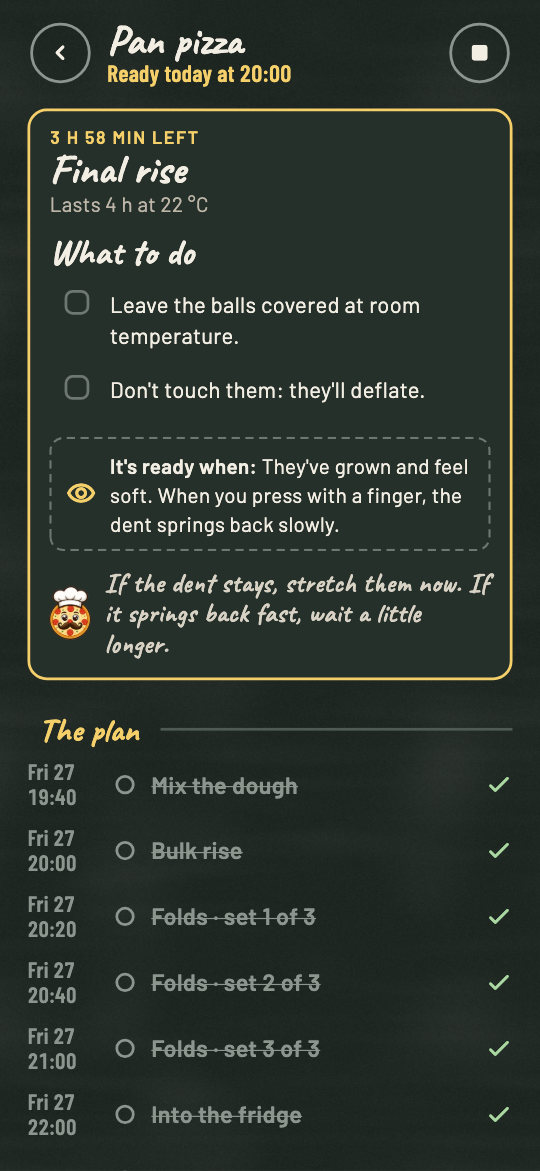
On pizza day, four hours before baking, pour two tablespoons of oil into the pan and spread it well, edges included. Tip the dough straight from the container into the middle of the pan, without pressing it down.
Now spread it with your fingertips, as if you were playing the piano: press and push outwards, starting from the centre. Don't pull it and don't use a rolling pin, which would crush all the bubbles that formed in the fridge.
Almost certainly, at some point, the dough will stop cooperating and spring back like a rubber band. That is the gluten, still cold and tight. Don't force it: cover the pan, wait 15-20 minutes and try again. It will have relaxed and will reach the corners without effort.
Then cover the pan and leave it at room temperature. In these hours the dough puffs up, fills with bubbles on the surface and becomes soft to the touch.
Step 4: the oven
Turn the oven on as high as it goes, 250 °C (480 °F) or more, at least 45 minutes before: a pan full of dough needs a truly hot oven. Top it with tomato and a drizzle of oil, without the mozzarella.
Bake on the lowest rack, because the bottom must cook and brown. After 12-15 minutes add the mozzarella, well drained and torn into small pieces, and put it back for another 5-8 minutes. That way the mozzarella melts without burning and without flooding the pizza with water.
To check if it is done, lift a corner with a spatula: the bottom should be golden and crisp. Let it rest for a couple of minutes on a wire rack before cutting, so the bottom doesn't go soggy.
The right pan
A blue steel or carbon steel pan, or thick aluminium, conducts heat well and gives a crisp, golden bottom: if you make pan pizza often, it is the purchase that makes the difference (Detroit-style pans are exactly this kind of heavy pan). Thin or non-stick pans work, but the bottom tends to cook less; put them on the lowest rack and, if your oven allows it, use only the bottom element for the first few minutes.
And don't skimp on the oil: besides stopping the dough from sticking, it lightly fries the bottom, which turns crunchy and fragrant.
If something goes wrong
The bottom is pale or raw. The oven wasn't hot enough, or the pan was too high up. Preheat for longer and use the lowest rack.
The pizza is low and dense. The dough was under-proofed, or it got pressed flat when you spread it. Use only your fingertips and wait until it is nicely puffed up before baking.
It is too tall and heavy. Too much dough for the pan: check the weight again with the square-centimetre maths.
The mozzarella is burnt or watery. Add it in the last few minutes, after letting it drain in the fridge for a few hours.
All the amounts
30×40 cm pan, every thickness
| Thickness | g/cm² | Dough | Flour | Water | Salt | Fresh yeast |
|---|---|---|---|---|---|---|
| Very thin | 0.25 | 300 g | 169 g | 127 g | 4.7 g | 0.29 g |
| Thin | 0.38 | 450 g | 253 g | 190 g | 7.1 g | 0.44 g |
| Normal | 0.50 | 600 g | 337 g | 253 g | 9.4 g | 0.59 g |
| Thick | 0.63 | 750 g | 422 g | 316 g | 11.8 g | 0.74 g |
| Very thick | 0.75 | 900 g | 506 g | 380 g | 14.2 g | 0.90 g |
- Very thin (300 g): crisp, almost a thin focaccia.
- Thin (450 g): low and crunchy, like thin Roman pizza by the slice.
- Normal (600 g): soft inside and crisp underneath.
- Thick (750 g): tall and fluffy, a classic home pan pizza.
- Very thick (900 g): like a tall focaccia or a Sicilian-style pizza.
Other pans
| Pan | Dough | Flour | Water | Salt | Fresh yeast |
|---|---|---|---|---|---|
| 25 × 35 cm (≈ 10 × 14 in) | 438 g | 246 g | 185 g | 6.9 g | 0.42 g |
| 30 × 40 cm (≈ 12 × 16 in) | 600 g | 337 g | 253 g | 9.4 g | 0.59 g |
| 35 × 45 cm (≈ 14 × 18 in) | 788 g | 443 g | 332 g | 12.4 g | 0.78 g |
| 40 × 60 cm (≈ 16 × 24 in) | 1,200 g | 675 g | 506 g | 18.9 g | 1.23 g |
| Round ⌀ 28 cm (≈ 11 in) | 308 g | 173 g | 130 g | 4.8 g | 0.30 g |
| Round ⌀ 32 cm (≈ 12½ in) | 402 g | 226 g | 170 g | 6.3 g | 0.39 g |
With more or less water
If it is your first pan pizza and 75 % scares you, start at 70 %: it handles almost like a dough for round pizza. Once you get the hang of it, go up to 80 %, with a flour above W 300.
| Hydration | Flour | Water | Salt | Fresh yeast |
|---|---|---|---|---|
| 65 % | 358 g | 232 g | 10.0 g | 0.62 g |
| 70 % | 347 g | 243 g | 9.7 g | 0.60 g |
| 75 % | 337 g | 253 g | 9.4 g | 0.59 g |
| 80 % | 328 g | 263 g | 9.2 g | 0.60 g |
With other timings
| Rise | Flour | Water | Fresh yeast |
|---|---|---|---|
| 8 hours, same day, no fridge | 337 g | 253 g | 0.57 g |
| 24 hours, 18 in the fridge | 337 g | 253 g | 0.59 g |
| 48 hours, 42 in the fridge | 337 g | 253 g | 0.43 g |
With MasterPIZZA
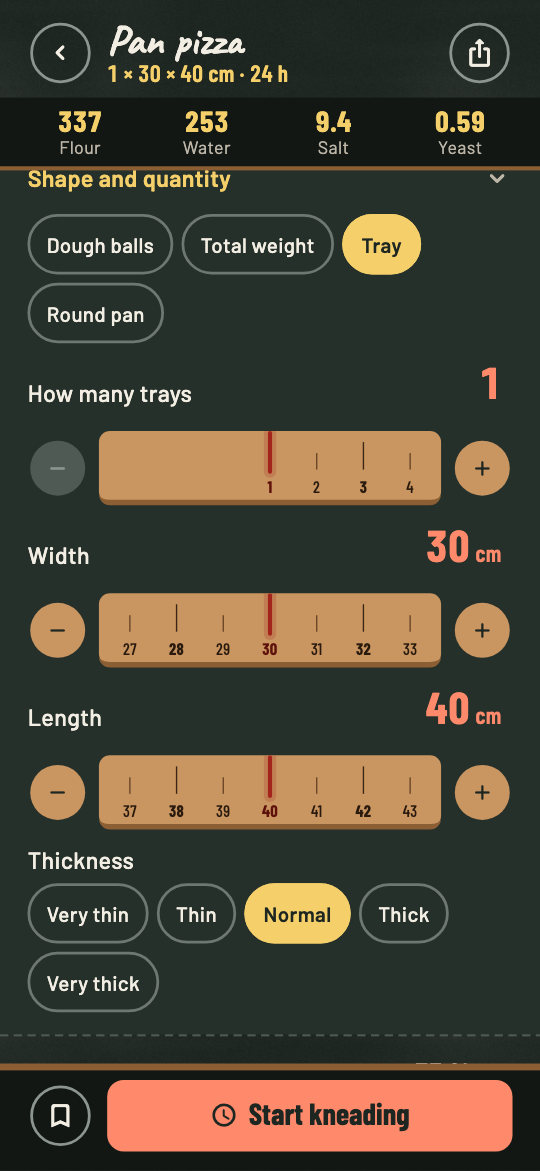
In the app, under Shape and quantity, you choose Tray, enter the width and length (or pick Round pan and enter the diameter) and the thickness you want. MasterPIZZA works out the weight of the dough and all the amounts, even for two or three pans at once, and recalculates the yeast for your hours and your kitchen.
Then the kneading guide walks you through it: it tells you when to mix, alerts you for every set of folds, for putting the dough in the fridge and for taking it out, even when the app is closed.
To better understand how to handle a dough this soft, read the guide to pizza dough hydration.
Questions
How much dough for a 30×40 cm (12×16 inch) pan?
For a normal thickness about 600 g: half a gram for every square centimetre. For a thin pizza 300-450 g is enough, for a tall, fluffy one 750-900 g.
How much flour for a 30×40 pan pizza?
At 75 % hydration, 600 g of dough takes 337 g of flour, 253 g of water and 9.4 g of salt.
How much dough for a 9×13 pan?
A 9×13-inch pan is about 23 × 33 cm, or 759 cm². At half a gram per square centimetre that is about 380 g of dough for a normal thickness, a little more if you like it tall.
How much dough for a Detroit-style pan?
A 10×14-inch Detroit pan is about 25 × 35 cm: around 438 g of dough for a normal thickness. Detroit pizza is usually thick, so many people go up to 0.6-0.75 g per cm², about 525-655 g.
How do I work out dough for a round pan?
Work out the area (radius × radius × 3.14) and multiply by half a gram: a 28 cm (11 in) pan is about 616 cm² and needs around 300 g of dough at normal thickness.
Why does my dough shrink back when I stretch it in the pan?
The gluten is still tight. Cover the pan, wait 15-20 minutes and try again: the dough relaxes and spreads without tearing. Don't pull it hard and don't use a rolling pin.
What hydration for pan pizza?
Between 70 and 80 %: more water makes the crumb more open and light, but the dough is harder to handle. 75 % is a good compromise for beginners.

Let MasterPIZZA do the maths
Pick your dough balls, hours and temperature: the app gives you the amounts to the gram and guides you step by step, with alerts. Free for Android.
Get it on Google Play ↗